

As America turns 250 this year, everyone with a Substack and a strong opinion is busy nominating the Most American Movie to play at their backyard birthday cookout. The usual suspects get trotted out, primarily war movies and films somehow dealing with government operations. Saving Private Ryan, Patton, Mr. Smith Goes to Washington — you get the idea. Born on the Fourth of July is beloved by people who want their patriotism served with a side of guilt (and Tom Cruise fake mustache enthusiasts). On the other political wing, Independence Day gets some votes from some who wouldn’t mind seeing the White House blown to bits.
All respectable choices. All wrong.
These movies share a flaw, which is that they are about America the institution — the government, the military, the historical set-piece, the Very Important Speech. They flatter us by treating American identity as something forged in Congress or on a beachhead, delivered by great men in front of great backdrops. It’s a fine tradition, if your idea of national character is best expressed through people who already have statues.
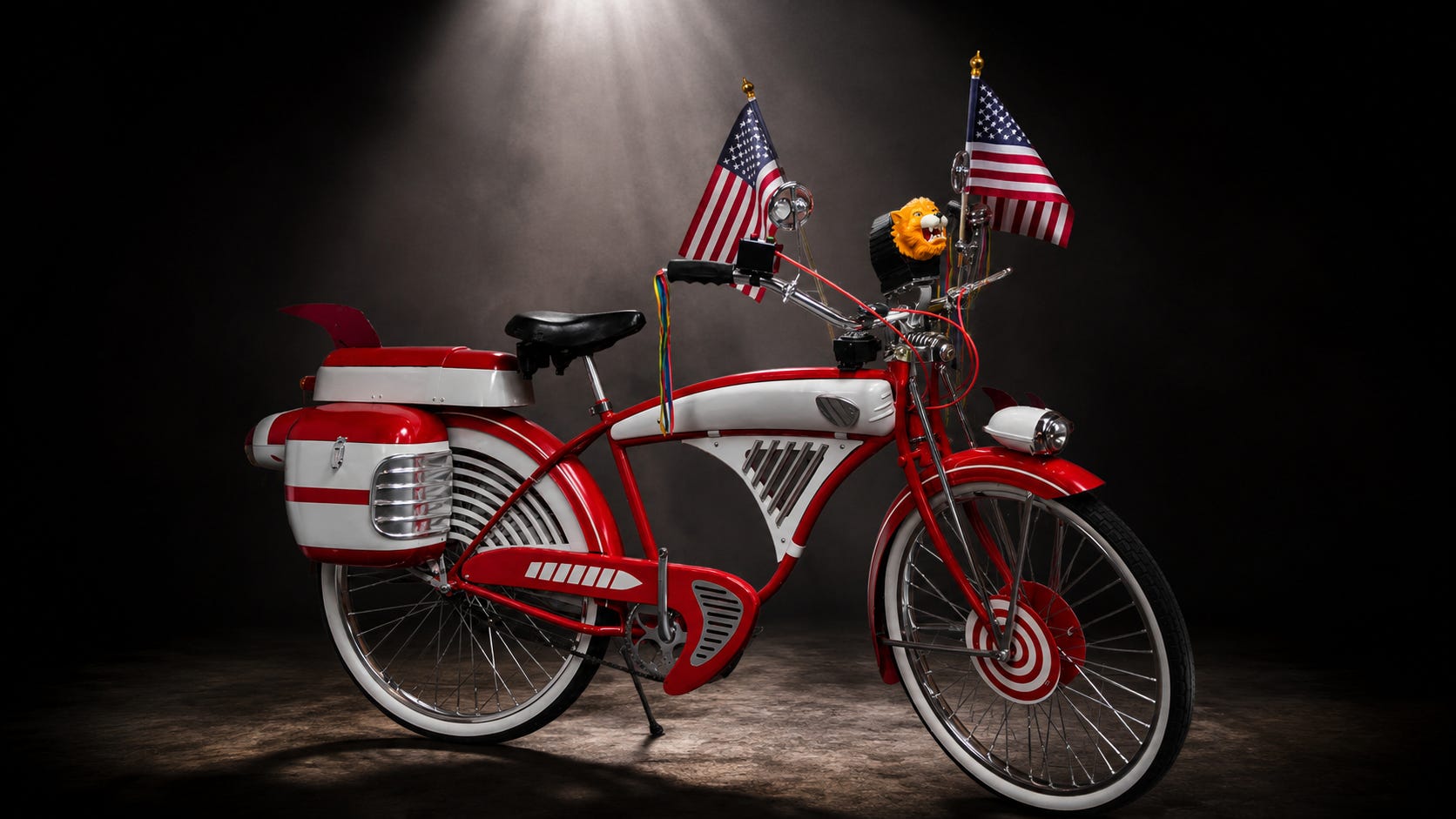
The real America — the one that’s actually produced 250 years of continuous, occasionally deranged self-invention — isn’t found in the Oval Office. It’s found in a man in a gray suit and red bow tie, pedaling a preposterous bicycle through his own front yard, at war with absolutely nobody except possibly the Soviet Union, who he is fairly sure stole his bike. I am talking, obviously, about the 1985 classic Pee Wee’s Big Adventure, the single most American movie ever made, and the fact that this needs to be argued at all in the year of our semiquincentennial is itself an embarrassment.
Start with the obvious: Pee Wee gets to live exactly the way he wants without a shred of interference from his neighbors. His house is a monument to unregulated small-business energy — a Rube Goldberg breakfast machine that exists for no reason except that he could build it, which is as close as cinema has come to visualizing the Bill of Rights. He waters his lawn with a toy that sprays water on the neighbor’s house, and nobody zones him. Nobody HOAs him.
Pee Wee is, in the fullest sense, free — free to be insufferable, free to be ridiculous, free to accuse a foreign superpower of bicycle theft with the complete conviction of a man who has never once doubted himself. (Pee Wee’s quiet life of blissful solitude may be a parable for the life of actor Paul Rubens himself, who pulled off the rare trick of coming out of the closet, then successfully going back in when he became world-famous.)
In fact, Pee Wee’s paranoid, reflexive suspicion of the Soviets is itself a period artifact worth savoring: even a man-child in a bow tie understood, circa 1985, that you kept an eye on Moscow.
When the bike disappears, Pee Wee does not call the police, hire a lawyer, or convene a task force. He hits the road — because no American identity crisis, in the history of the republic, has ever been resolved by staying home. What follows is a genuinely manifest-destiny-shaped odyssey through diners, truck stops, and roadside Americana, the heartland rendered as a theme park of national mythology: the Alamo (which, in the film’s best joke, does not have the basement he’s counting on, a fact that stops him for exactly zero seconds), the open highway, and eventually Hollywood itself, tribute to the most American of all industries, the one that turns humiliation into spectacle and somehow calls it art.
The Hollywood sequence alone runs through nearly every genre American film has ever exported to the world — western, war picture, monster movie, even a full Twisted Sister music video. Somewhere in there Pee Wee also gets his moment of American heroism, playing vigilante against a studio full of executives who wronged him, dispensing justice on his own terms because no institution was ever going to do it for him. No Charles Bronson movie ever delivered such delicious revenge.
Along the way he picks up Large Marge, a trucker ghost story delivered completely deadpan to a hitchhiking stranger — as pure a piece of American campfire folklore as you’ll find, twist ending and all, the kind of tall tale this country has been telling itself since before it had a flag. And notice who Pee Wee moves among on this trip: an escaped convict, biker bar toughs, small-town waitresses, eventually studio executives, all treated with the exact same guileless enthusiasm. Class means nothing to him. He is a one-man rebuke to the idea that Americans are supposed to stay in their lane, a trait this country claims to value and mostly doesn’t practice, except here.
And then there’s the ending, which is where the movie earns its claim outright. Pee Wee’s cross-country catastrophe — his bike stolen, his dignity repeatedly destroyed, his heroics limited to an accidental barn fire — gets turned by Hollywood into a triumphant blockbuster, complete with James Brolin playing a version of him who’s actually competent. Is that redemption, or is it shameless spin? The film wisely refuses to pick a side, because America has never picked a side on that question either. We have always preferred the myth to the mess, and we have always been willing to let a disaster get a sequel.
There is no better image for a country turning 250 than that: absurd, sincere, self-mythologizing, and marching forward regardless. Happy birthday, America. Pee Wee already knew who you were.