

If you enjoyed this post, won’t you please consider subscribing? Clicking below will keep the party going!
There is nothing funnier than watching other people laugh. Laughter is one of those biological responses that can be triggered by others, just as seeing someone cry can make others cry. Humor is infectious — it can travel through the air and attack your brain, and no amount of ivermectin can cure you of it.
But seeing other people guffaw is also the easiest way to make other people laugh, which is why Saturday Night Live founder and executive producer Lorne Michaels has always frowned on cast members “breaking” on-air. From the inception of the show in 1975, Michaels has said he didn’t want SNL to be the Carol Burnett show.
From the classic book Saturday Night by Doug Hill and Jeff Weingrad, which documented SNL’s creation:
Lorne did, however, lay down some ground rules, in the process outlining an attitude toward the show. Saturday Night would do sketches, not skits; kids do skits, he said, and so did Carol Burnett.
Lorne made it clear that Burnett’s style encompassed everything Saturday Night should avoid. It lacked subtlety and nuance; it was too broad, too bourgeois, and too smug—especially when the performers broke out laughing in mid-sketch, doubling up at the hilarity of themselves. There will be more integrity and respect for the writing here, he said. From then on many an idea would be derisively dismissed on the 17th floor with the words, “That’s Carol Burnett.”
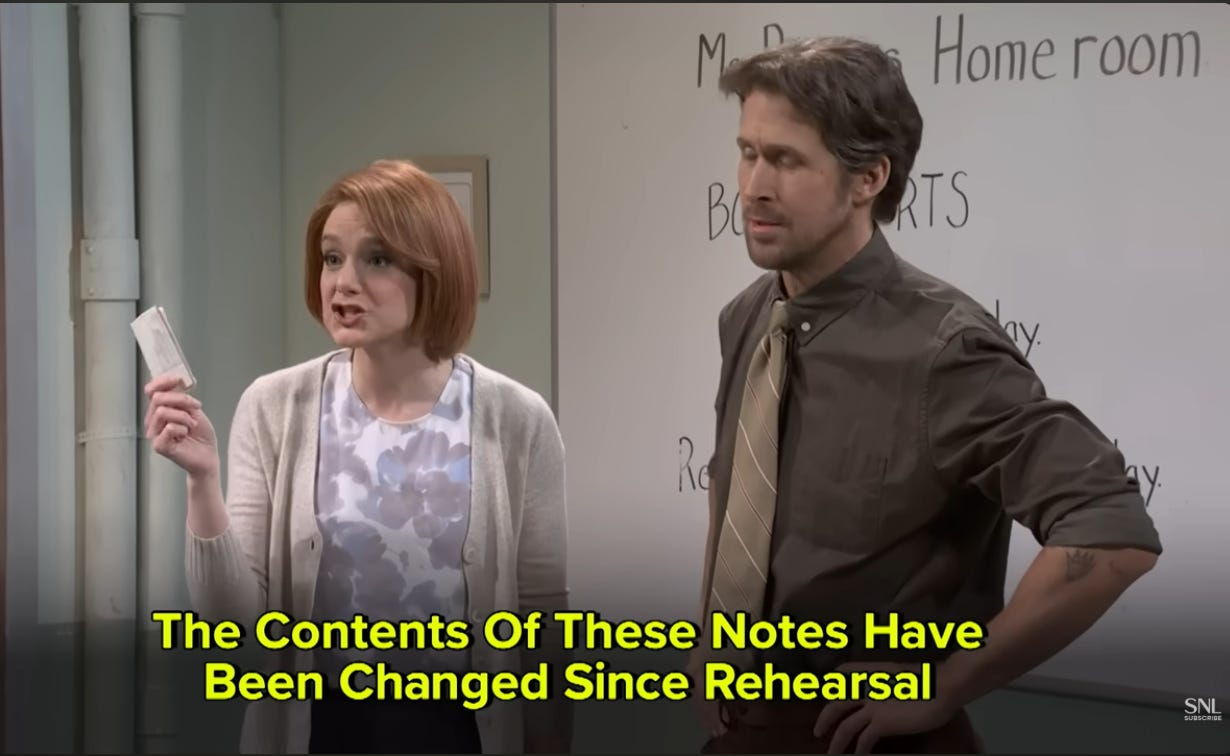
On this week’s show, SNL finally obliterated that foundational rule. In a sketch featuring Ryan Gosling as a school principal and cast member Ashley Padilla as a teacher, a chyron near the bit’s beginning announced that the material the actors were reading had been changed since the final rehearsal. Viewers were effectively being told that the cast members would be as surprised as they were at what they were reading, with the understanding that there is no way they could keep a straight face.
And they didn’t. Padilla, the show’s best cast member, took a note being passed by her class and read it out loud, unable to hold her laughter in. She and Gosling, a notorious breaker, took turns unwrapping notes taken from her students, each struggling to get through the sketch without crying with laughter.
Viewers undoubtedly laughed because if there is anything funnier than watching someone else laugh, it is watching someone trying desperately to avoid cracking up. But the sketch marked an important shift in SNL after 50 years: it was the first to try to make the cast members break. Lorne’s golden rule is now gone, and while the sketch elicited laughs, were they the right kind of laughs?
Obviously, people break on SNL all the time. Gosling is a notorious laugher (see: the famous Beavis and Butthead sketch from a few years ago, which made the otherwise stoic Heidi Gardner break), so perhaps writers this week decided to really lean into it and write a sketch that requires him to do so.
But breaking can also ruin a sketch. The early 2000s were full of bits obliterated by Jimmy Fallon and Horatio Sanz bursting into laughter because the sketch wasn’t doing well, and they likely knew they could squeeze some snickers out of the studio audience if they broke character. This habit of Fallon’s irked Tracy Morgan, who in a 2007 interview said, “Laughing and all that dumb shit he used to do — he wouldn’t mess with me because I didn’t fucking play that shit. That’s taking all the attention off of everybody else and putting it on you, like, ‘Oh, look at me, I’m the cute one.’ I told him not to do that shit in my sketches, so he never did.”
(For a more complete list of cast members breaking, check out this 2025 piece from The New York Times, in which I am actually quoted. Is “SNL breaking expert” considered an actual profession?)
And then, of course, there is Stefon.
Bill Hader’s famous Weekend Update character, Stefon, was largely written by then-staff writer John Mulaney, who has said he would change lines between rehearsal and air just so Hader had to read them for the first time in front of millions of people. Mulaney knew this would get Hader to crack up, sending the audience into a frenzy.

Hader has said he felt terrible about all the breaking he did as Stefon. He apologized to Lorne for destroying the “breaking” rule, and Lorne’s response is the perfect way of explaining when breaking is acceptable and when it is not. From the book Live From New York, an oral history of SNL by Tom Shales and James Andrew Miller:
HADER: I went to Lorne at an after party once and I said, “I’m very sorry I keep breaking as Stefon. I’m a little nervous because I’ve broken every single time I’ve done it, so now I feel that the audience is waiting for me to break, and I feel a lot of guilt about this.” And Lorne said, “Well, if what you’re saying isn’t funny, then we have a problem. But what you’re saying is so outrageous, everyone’s laughing. It’s when what you’re saying isn’t funny and you’re trying to save the sketch, or you’re trying to pull focus away from other performers, or pull focus away from the idea of the sketch and the writing and just trying to pull it all to you, then that’s when we have a problem.” And I said, “Okay.” I think Lorne secretly loved it because the audience thought it was great. But I should say for the record, every time I broke, I would get angry with myself. I would laugh up there and then this feeling of guilt would kind of ebb through me of guilt. I’d feel very guilty. So after most Stefons, I’d have my head down and I’d be pissed because I’d laughed.
So yes, Mulaney was trying to get Hader to break, which may share some DNA with this week’s Gosling/Padilla sketch. But a Weekend Update bit is very different than a full sketch. And it is also a completely different thing for the show to admit to the audience that a sketch is effectively an improv exercise designed to make the actors burst into laughter. That not only had never been done before, it is anathema to the show’s most fundamental genetic makeup.
Without a doubt, a show like SNL that has been on the air for 50 years needs to adapt, or it will die. Twenty years ago, the show began incorporating digital shorts from Andy Samberg and his pals in The Lonely Island, and it revolutionized the way fans watched the show - suddenly, there were pre-taped viral moments viewers could watch at home on YouTube. It kept the show fresh and relevant.
But Saturday’s sketch was even more historic in that it crossed a line that had never before been violated. Yes, the show needs updating, but its ethos of breaking has worked for half a century — if it now routinely erases that fundamental standard, there might not be much of a show left.
(For a lot more on Saturday Night Live, check out Wasn’t That Special: 50 Years of SNL, my podcast that summarizes and analyzes every season of the show.)
I didn't find the sketch funny at all. And the character breaks seemed forced. What made the Carol Burnett breaks funny was the involuntary hilarity that occurred mostly between Harvey Korman and Tim Conway. Conway was arguably one of the funniest comedians of that era, and it seemed genuine when Korman would attempt to stifle his laughter.
Check out the number of views on some of those old Carol Burnett skits. They’re golden.