

In Latin, there’s a term for the need to speak well of the recently deceased — de mortuis nil nisi bonum, or “say nothing but good about the dead.”
There seems to be less guidance on speaking about people for whom earthly exit is imminent. Former U.S. Senator Ben Sasse, for instance, is wracked with terminal cancer and will be leaving his human body soon. He has thus packed several decades of future wisdom into the remaining months he has left, explaining his worldview in media outlets far and wide. This includes his own podcast, where he has been able to chew the fat with Conan O’Brien and Chris Pratt.
It is therefore with trepidation that I tiptoe into disagreement with one of Sasse’s parting arguments. In February, just before the Seattle Seahawks destroyed the New England Patriots in Super Bowl XLIX, Sasse penned a column for the Wall Street Journal’s Free Expression newsletter that argued politics should be more like football — fans arguing like hell during game time, but then shaking hands and living our lives in tranquility afterward. (I am a contributor at the same outlet where Sasse wrote this piece, so think of this as a friendly disagreement among colleagues.)
“America would be a healthier place if we treated civics more like a Super Bowl party,” Sasse writes. “Make it general admission. Open up more space for people who care but aren’t obsessed. Pick sides. Argue calls. Talk a little trash. Some diehards will show up with face paint, but they’ll always be a minority.”
Sasse’s heart is in the right place — who doesn’t want an America where people aren’t vilified because of their political views, just as they aren’t shunned because they cheer for the New York Knicks? (Rooting for, say, the Minnesota Vikings or Chicago Bears does display a lack of character, but as a Green Bay Packers fan, I maintain these people should still be allowed in public.)
But Sasse gets it backward — the problem with politics today is that we already treat it too much like sports. Athletic competitions are an entertainment product with a zero-sum outcome; either your side wins or loses. And this win-at-all-costs mindset has drenched politics in anger and vituperation.
Sports are fun because they are ultimately meaningless. You can root for your team until your voice is hoarse, but in the end, it doesn’t make any difference in your everyday life whether your team wins or loses. Sure, it can give you a sugar high — I was deliriously happy for weeks after my Milwaukee Bucks won the NBA championship in 2021, but my day-to-day routine hasn’t changed at all. (I keep checking my mailbox for my “Bucks world title check,” and it has yet to arrive.)
It is the meaninglessness of athletics that allows us to lose our minds and say outrageous things during a game, then revert to a normal functioning human being afterward. Obviously, the word “fan” comes from “fanatic,” or “a person with an extreme, uncritical, and often obsessive enthusiasm or devotion to a cause, belief, or activity.” With sports, there is no harm in losing your mind –- fans regularly ditch reason, evidence, and sanity when arguing calls or questioning coaching decisions. It is not only accepted but encouraged.
But all the delusions of being a sports fan have now transferred to the political world. To be a fan of one side or the other, dissent is not tolerated — you’re either all-in, or you’re a fair-weather supporter. In actuality, politics is a slow, grinding process — a civic three yards and a cloud of dust (or a cloud of hot air if you watch speeches given from the Senate floor for any period of time.)
But the politics-as-sports formulation has given us the current “you’re with us or you’re against us” attitude that has wrecked nuance and common sense.
Democrats, for instance, spent most of 2023 and 2024 arguing that as he sought a second term, aging President Joe Biden was the picture of mental acuity. Saying out loud what everyone could see with their own eyes was enough to get you excommunicated from the party; eventually, it ended in catastrophe.
Even now, Democrats are defending Graham Platner, a total fraud running for the U.S. Senate in Maine. Virtually everything about Platner’s career as a soldier and working-class oysterman is a lie, and he now faces accusations of physically assaulting former girlfriends and sexting up to six women who weren’t his wife. And yet Democrats, knowing they need Platner for their “team” to win the Senate in November, offer bogus excuses as to why they continue to support a proven reprobate.
(Let’s not even get started about the members of the media lionizing insufferable blowhard Scott Pelley, who recently made a point to get himself fired from 60 Minutes, then windbag his way into some high-profile interviews where he held himself up as the paragon of media virtue. Anyone blind to this self-mythologizing gambit is purposely making themselves stupid because they agree with Pelley’s liberal politics, plain and simple.)
Meanwhile, team discipline on the Republican side is enforced even more vigorously (and, ironically, one of the reasons Sasse left the Senate.)
Being a Republican these days means pretending cretins like Herschel Walker, Ken Paxton, Roy Moore, and Todd Akin belong in the U.S. Senate. And to remain a member of the GOP in good standing, one must believe the following:
The 2020 election was stolen;
Jan. 6 rioters deserve billions in taxpayer money because of their hurt feelings;
Tariffs don’t raise prices;
The government should own large stakes in private companies;
Vaccines cause autism; and
That Rob Schneider is funny.
Each one indefensible.
Yet this is what “let’s treat politics like sports” has wrought. Only politics isn’t sports. Politics is important. It sometimes dictates who lives and who dies. It regulates people’s livelihoods, determining the quality of life they can live. Who we elect makes a difference in how much money we make, how our kids are educated, and what freedoms we enjoy.
What Sasse actually wants — and what most sane people want — isn’t politics as sport. It’s politics as civic obligation: something you take seriously enough to engage with, but not so seriously that you lose your soul to it. A thing you can argue about with your brother-in-law at a cooking without him ending up with a shish kebab sticking out of his neck — a mechanism for organizing a free society, not a vehicle for self-actualization.
The problem is that the sports metaphor has already colonized the language. We talk about “winning” elections, “crushing” opponents, “owning” the other side. President Donald Trump, a Knicks fan when they are winning, speaks as if he is a typical caller to a sports radio program. Political media is organized around highlights and outrages, not arguments and consequences. The game clock never runs out, and the season never ends, so the adrenaline never dissipates.
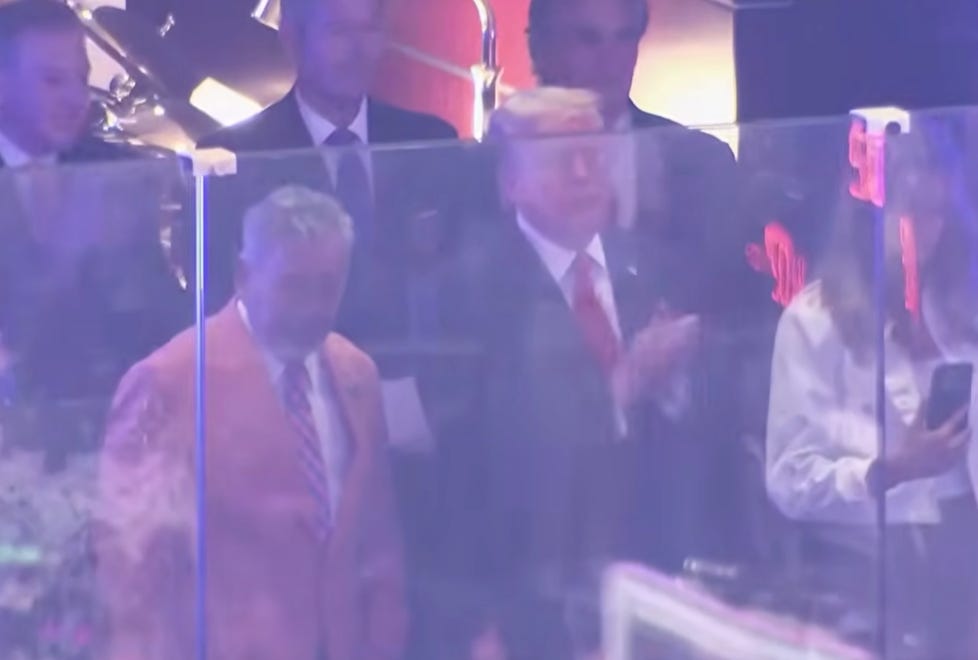
Sasse has spent the better part of a lifetime trying to be a voice of reason in an institution that increasingly punishes reasonableness. For that, he deserves genuine admiration. But the cure for treating politics like football is not better sportsmanship — it’s remembering that when the game ends, real things happen to real people. The only answer is to fight like hell to elect people who vow to be less important in our lives, not people who jam up entrance to an NBA finals game for hours just so they can see the game in person.

We all live in fear that we will one day lose a loved one to a cult, but some cults can actually be good for people. People who join CrossFit are undoubtedly healthier than the average American, even if they can’t shut up about it. Half of the social media site Threads is people (and a lot of bots) discussing their boring journey to sobriety. Good for their livers, bad for my attention span.
Similarly, if you have been cornered by an earnest young man in the past couple of years, you have no doubt been counseled as to the benefits of stoicism. This ancient philosophy effectively teaches people to let go of the things they can’t control. (I have even written about it here.) Effectively, stoicism says that if you base your personal happiness on all the external things happening in the world, you will always be disappointed. (Even modern philosopher Jerry Seinfeld has taken up the cause of the Stoics.)
Given politics today, I have tried hard to make this happen. As a writer, I try to convince people where I can, but if I’m not successful, I don’t take it personally. It is impossible to reason people out of a position that they didn’t use reason to get into, so why make myself miserable?
But there is one thing I cannot let go of. And that is the fact that being a sports fan is incompatible with practicing stoicism. (See above.) As sports fans, we cannot dictate how our teams or favorite players perform. And yet I cannot let it go. My personal happiness is often predicated on whether a 22-year-old catches a football or dribbles a basketball off his foot.
If I were able to adhere to the Stoic philosophy, I could do as Ben Sasse recommends — cheer during the games, then turn off my fandom and go back to living a regular life. But I cannot. Sports is out of my control, and yet I cannot help but take it personally if a team from my geographic area loses to a team from another geographic area. It is as if I have been proven to be a substandard human.
So even while stoicism seems to be having a moment — no doubt in large part as a counter to social media, which demands people care deeply at all times about total bullshit — it has its limits. The ancient philosophers may have had a point regarding culture and politics, but Marcus Aurelius has never had his heart ripped out by a Packers playoff loss.

After three years, thousands of hours of work, and over 1.2 million words spoken, my Saturday Night Live podcast, Wasn’t That Special, has effectively wrapped up. My co-host, Scot Bertram, and I have decided to throw open the vault and make the podcast totally free to anyone who wants to listen — previously, it had been limited to paying subscribers. So head on over and listen to the most complete chronicle of SNL history that has ever been compiled - all for free-ninety-nine.
Our podcast wrapping up SNL Season 51 is here.
And our podcast recapping SNL UK Season 1 is here.

My favorite podcast, One Song, recently tackled “Whip It” by Devo, with band members Mark Mothersbaugh and Gerald Casale in the studio to discuss how they put the song together. Watch it here:
The former, aspiring Byzantinist in me shudders at any call to make politics and sports more similar or entangled. https://en.wikipedia.org/wiki/Demes_in_the_Byzantine_Empire
I would offer a friendly amendment - politics shouldn't be more like *entertainment*, of which high attendance/viewing/profile sports is a distinct subset**. Granted sports has the advantage for our primate minds of having clearly delineated winners and losers, something largely missing from other entertainment forms. There's obviously a long history of entertainment aspects to politics (not *just* team and fandom building exercises), but I suspect the overlap has greatly increased in the last few decades.
I *suspect* that the fact that Presidential political systems conflate the dignified and efficient (H/T Bagehot) parts of government more than Parliamentary systems plays some role there too (though looking at e.g. the UK or Canada shows creep of the Bagehottian :) dignified role onto the PM).
Obviously consider me to have made a nod toward "to understand Trump, understand 'professional' wrestling".
** It always struck me as a category error that in the newspaper, back when there were such things, sports and entertainment had separate sections; my local fishwrap, the LA Times, still has a dedicated sports section but now only has a dedicated entertainment section in the Sunday edition. Then again I'm one of those weird, bordering on autistic, people who really doesn't "get" fandom as a social/psychological phenomenon, so it's unsurprising that I wouldn't be able to create a realistic theory of mind that would cover sports fandom.