

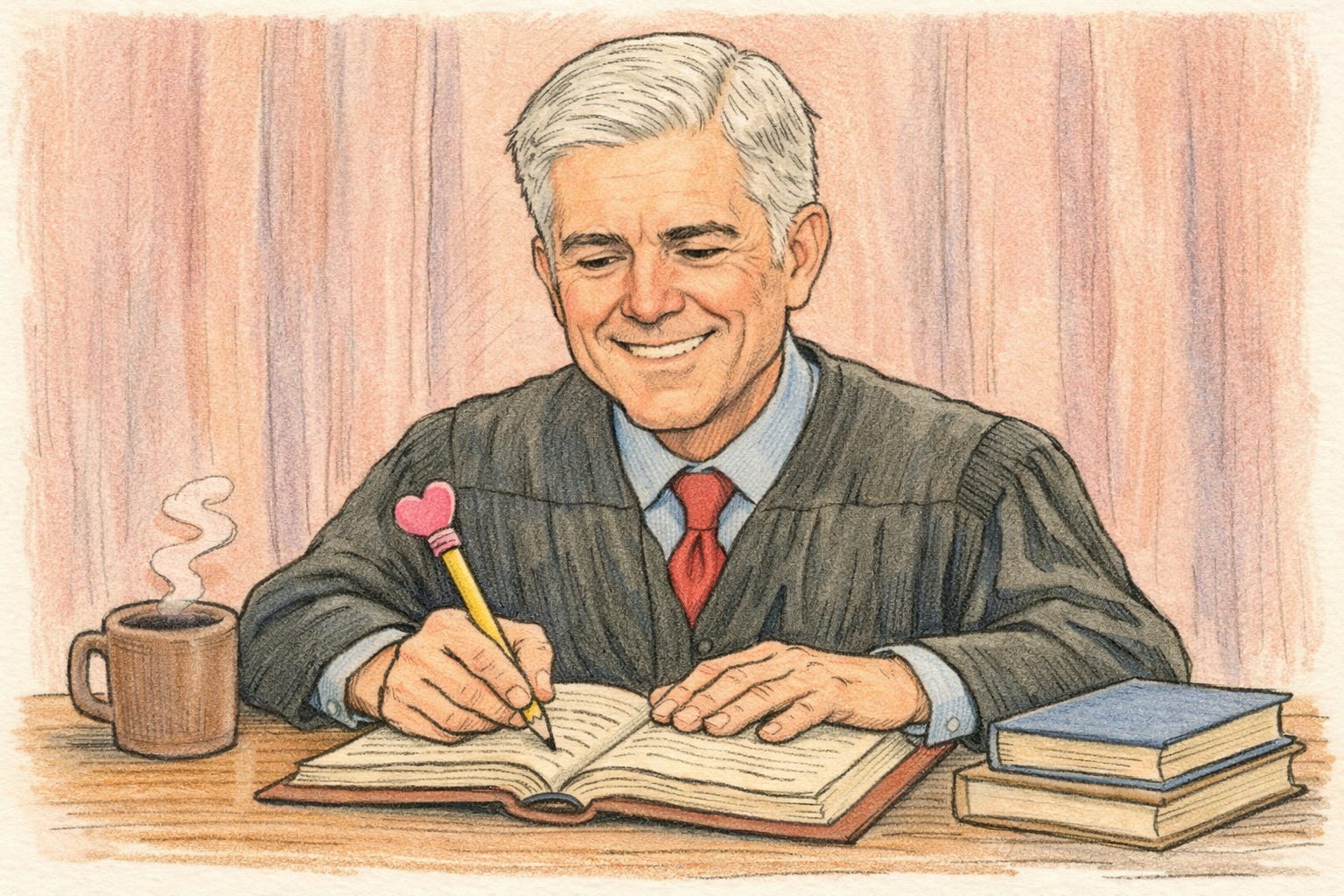
The Supreme Court’s ruling last week in Learning Resources, Inc. v. Trump struck down President Trump’s sweeping IEEPA tariffs. The majority opinion was important, but the most revealing document in the case wasn’t the majority — it was Justice Neil Gorsuch’s concurrence, a precision instrument designed to expose how his colleagues have each, in their own way, interpreted the law not as written but as politically convenient.
Gorsuch’s opinion is merciless, serving up a hearty feast of vituperation. He picks apart his colleagues one by one — the progressive bloc, the conservative dissenters, and finally his own ideological ally, Amy Coney Barrett — and demonstrates that virtually everyone on the court has been willing to bend their interpretive principles when the other side’s president was unilaterally legislating.
Start with the liberals. Justices Kagan, Sotomayor, and Jackson joined the majority opinion and reached the right result: IEEPA does not grant Trump the power to impose tariffs. But rather than endorse the major questions doctrine — the rule that courts should demand clear congressional authorization before allowing the executive branch to exercise extraordinary power — they insisted they could get there on plain statutory interpretation alone. In their telling, the word “regulate” in IEEPA simply doesn’t cover tariffs, full stop. No special canon needed.
In other words, in denying the major questions doctrine was applicable here, the liberals argued it walked like a duck and quacked like a duck, but was instead a warthog.
Gorsuch was not having it. He spent the first third of his concurrence cataloguing the exact opposite position these same justices took when Democratic presidents wielded power through expansive statutory authority.
To wit: When the Biden administration’s OSHA tried to impose vaccine mandates on 84 million Americans, Kagan and Sotomayor dissented, arguing the statute’s “expansive language” clearly covered it. When the CDC tried to regulate landlord-tenant relations nationwide through eviction moratoriums, they said the broad statutory language permitted even “greater restrictions.” When the EPA sought to effectively restructure the entire electricity industry through the Clean Air Act, they argued that the statute’s text was “broad” and “expansive” with “no ifs, ands, or buts.” When the Education Department tried to cancel $430 billion in student loans, they said the relevant terms were “capacious” and designed to afford a “potent” power to respond to “national emergencies that were major in scope.”
In every one of those cases, the three justices took the position that broad language in major legislation meant broad power for the executive — and specifically for whichever agency a Democratic president controlled. Now, confronted with IEEPA’s comparably broad language granting powers to a Republican president, they suddenly discovered contextual clues, structural concerns, and statutory nuance limiting that power.
Gorsuch does not accuse them of bad faith. He’s too subtle for that. He simply holds the mirror up and asks: if “regulate importation” in IEEPA doesn’t grant sweeping executive authority, why did “safe and healthful working conditions” in the OSH Act grant sweeping executive authority? The logic is identical. The outcome depends entirely on who’s wielding the power.
But Gorsuch doesn’t stop with the liberals — he turns his pen on his fellow conservatives in dissent. Justices Kavanaugh, Thomas, and Alito would have upheld the tariffs; Kavanaugh wrote the main dissent, and crucially, he claimed to accept the major questions doctrine — he just thought IEEPA satisfied it.
Gorsuch is polite but unconvinced. He walks through each of the four factors courts use to assess whether a statute clearly authorizes an asserted power and concludes that Kavanaugh’s dissent amounts to “grade inflation.” The fact that no president for nearly half a century invoked IEEPA to impose tariffs — not one percent on one product from one country — should by itself settle the question of whether this is a “newfound” power claimed from an old statute. Kavanaugh waves that away. Gorsuch does not.
More pointed is Gorsuch’s observation about what happens if the dissenters win. A ruling for Trump, the president’s own lawyers acknowledged at oral argument, would afford future presidents the same latitude. This means a Democrat could invoke IEEPA to impose tariffs on gas-powered vehicles to address climate change. Or tariffs on any imports for any emergency any president perceives — and those emergency declarations would be unreviewable.
Gorsuch asks his conservative colleagues a simple question: What president would willingly give up that kind of power? The same conservatives who spent years warning about executive overreach were now, under a Republican president, defending the most unconstrained assertion of executive tariff power in American history.
And then there is Amy Coney Barrett.
Barrett joined the majority and signed on to the major questions analysis. She is, by the result, on the right side of this case. But she has spent years arguing that the major questions doctrine should be reframed as a “commonsense principle of communication” rather than a “substantive canon” designed to enforce Article I of the Constitution. In her view, the doctrine is really just what any reasonable English speaker would infer from the statutory context — not a judicially imposed rule requiring Congress to speak with extraordinary clarity when delegating extraordinary power.
Gorsuch addresses this argument with patience and care, but he dismantles it completely. He runs through case after case where the major questions doctrine produced results that had nothing to do with “common sense” — cases where the agency had perfectly reasonable textual arguments, where any ordinary reader might have concluded the statute said what the agency claimed it said, and where the court still ruled against executive power on the grounds that Congress had not spoken clearly enough.
Calling something “common sense” doesn’t make it common sense. Tobacco is clearly a drug by any ordinary meaning. Greenhouse gases obviously pollute the air. Eviction moratoriums really do prevent the spread of disease. Common sense is doing no work here — what’s doing the work is a clear-statement rule grounded in Article I’s vesting of legislative power in Congress.
Barrett’s framing, Gorsuch argues, is ultimately incoherent. It toggles between a clear-statement rule and nothing at all, depending on how much “skepticism” feels appropriate in a given case. The problem is that “how much skepticism feels appropriate” is exactly the kind of discretion the major questions doctrine was meant to eliminate — the discretion to find congressional clarity when you want to and congressional ambiguity when you don’t.
What ties all three critiques together is a single underlying observation: the justices on this court have been inconsistent, and their inconsistency tends to track their political priors. The liberals read statutory power broadly when Democrats wield it, narrowly when Republicans do. The conservatives applied the major questions doctrine aggressively against Biden’s agencies and then, when confronted with Trump’s tariffs, suddenly discovered that IEEPA said what it needed to say. And Barrett sought to soften the doctrine’s edges precisely in a way that preserved judicial flexibility — which is another way of saying preserved judicial discretion to reach preferred outcomes.
Gorsuch’s concurrence is unusual in American legal writing because it criticizes nearly everyone. It is self-aware about the court’s tendency toward motivated reasoning without being cynical about the enterprise. He believes in the major questions doctrine, he makes a serious case for it, and he uses this moment — when everyone is converging on the same result for different reasons — to insist that the reasoning matters, not just the outcome.
He is right about that. Courts that reach the right answer for the wrong reason, or for reasons they will quietly abandon the next time the political winds shift, are not building law. They are adjudicating outcomes. The lesson of Learning Resources isn’t just that IEEPA doesn’t authorize tariffs. It is that the rule of law that requires the same interpretive framework to apply regardless of who is president.
Gorsuch’s concurrence is a reminder — addressed to every faction on the court — that they haven’t always met that standard. Whether any of them takes it to heart is another question entirely.

More Supreme Court stuff from me at National Review this week. I take on the age-old claim that the court is “secretive,” when, in fact, it is the most transparent branch of government:
When the Court’s 6–3 majority struck down the president’s sweeping tariffs under the International Emergency Economic Powers Act, it did not simply say no and adjourn for an afternoon of pickleball. Chief Justice Roberts wrote a full majority opinion explaining exactly why the IEEPA does not hand the president unlimited authority to impose tariffs of any size, on any country, for any duration he chooses. He cited prior cases, walked through the statutory text word by word, and laid out Congress’s Article I power to set trade policy. You can disagree with every sentence, but you cannot accuse the man of hiding his work.
That is how every Supreme Court decision works. Nine unelected lawyers in black robes are the only people in Washington constitutionally required to explain themselves in writing. Every ruling carries a majority opinion that must lay out the legal reasoning in enough detail to be cited, challenged, and built on for decades. Dissents are published alongside the majority, meaning the losing side airs its objections in the same document, for all of history to read.
Read the full thing here.

Morrissey famously sang “We Hate it When Our Friends Become Successful,” but I couldn’t be happier that my pal Robert George has suddenly become the face of Gen X music. He has now appeared twice on the viral show “Track Star,” in which they quiz regular people (and celebrities) on their music knowledge, and Robert has shown himself to be a grandmaster of knowledge.
He was recently invited back for a full hour discussion of my generation’s culture - watch it here:

I usually provide some background on the last musical piece I add at the end of my newsletters, but not this time. I just love this song.
A very interesting piece, thank you. I do, however join Sawdust in his comment. There have been more cases decided on the shadow docket on issues involving Trump than in actual written decisions. Transparent? I disagree.
A notable exception, the shadow docket. The court often gives no argument but scolds lower courts for not following the decision. If no reasoning is offered, ones guess is as good as another.