

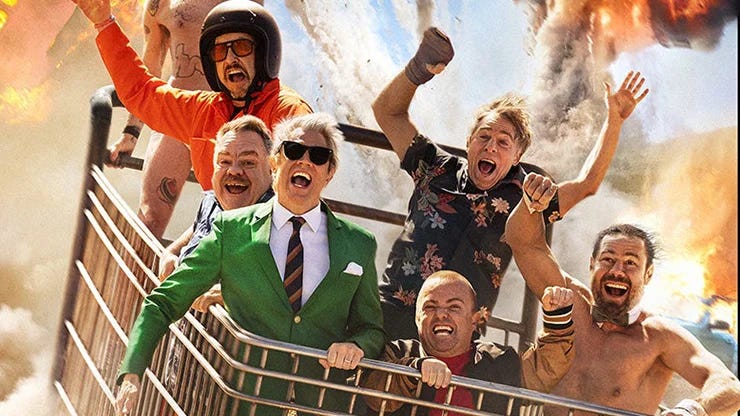
In the fall of 2000, MTV debuted a show the critics dubbed “heinous,” “repugnant,” and “reprehensible.” Knight-Ridder’s Chuck Barney said the network was spending millions to present young men to the world “as whacked-out morons.”
Indeed, a quarter-century ago, it seemed that the “Jackass” television franchise was what was wrong with America. But in 2026, as the franchise says goodbye with its final film release, “Jackass” can show us the way to make the country right again.
This is not merely contrarian revisionism, either. Even the critics, who once treated the show as evidence of America’s moral collapse, have started coming around. Reviewing the latest “Jackass” film twenty-five years after Barney’s takedown, Roger Ebert’s site conceded that the cast “haven’t changed as much as the world has come to recognize their special form of insane genius.” High praise from a critical establishment that once wanted these men committed rather than filmed.
For a decade now, social observers have spilled millions of pixels and podcast hours kvetching about the “male loneliness epidemic.” They worry about young men who rarely leave their homes, who make most of their friends online, who play video games all night, and sleep all day. Their secluded existence prevents them from learning to interact with other people, especially women. These men never experience the joys of male friendship, leaving them bitter, combative, and underformed as humans.
The numbers back this up. The Survey Center on American Life found that 15 percent of men now report having no close friends at all—a fivefold increase since 1990, when the figure sat at 3 percent. Over the same period, the share of men with six or more close friends has been cut roughly in half, from 55 percent down to 27 percent. It’s serious enough that the U.S. Surgeon General has compared the mortality risk of chronic loneliness to smoking fifteen cigarettes a day—a habit that, statistically speaking, turns out to be more hazardous than letting your buddy fire a bottle rocket out of your anus.
“Jackass,” of course, features a band of delightful imbeciles engaging in dangerous and tasteless stunts to impress one another. The practical jokes they play on themselves and the unsuspecting public are, to put it mildly, often rude, profane, and scatological. Led by Johnny Knoxville and “Steve-O,” this “band of merry dimwits” (as dubbed by Barney) strap themselves to rockets, overturn occupied port-o-potties, place toy cars in their rectums, and concoct untold numbers of ways to punish each other’s reproductive organs. (Anyone who has watched all of the “Jackass” franchise movies will have seen more male genitalia than one needs to view in medical school to become a urologist.)
But while the means of delivering this message of masculinity are often gag-inducing, there is a touching portrayal of healthy male friendship found deep within these obnoxious louts. These pranks and stunts are friends delivering punishment to other friends, trusting each other even when they clearly shouldn’t. No matter what torture they endure for each other, they always know that in the end, they are going to share a hug and a laugh.
It is within these oppressive structures that males form the best friendships—whether in the military, on a sports team, or by covering a friend with honey and salmon and letting a bear in the room while your friend is chained to a chair. Dire circumstances demonstrate who truly has your back, and once proven, those bonds can rarely be broken.
Not every bond survives the stunt work, of course. “Best and Last” includes footage of Ryan Dunn, who died in a 2011 car crash, and leans hard into Bam Margera’s real-life estrangement from the group, including the lawsuit that followed his firing from an earlier film. Critics have singled out this material as the movie’s most affecting, and rightly so—it’s proof that the fraternity on display here isn’t cartoonishly indestructible. Some of these friendships genuinely broke, or ended too soon, which only sharpens the point: the ones that held up over twenty-five years are worth admiring precisely because they didn’t have to.
Plus, the “Jackass” guys are getting out of their homes, engaging in physical activity, and being creative. It’s as if Michelangelo himself had chosen human feces as his medium.
Surprisingly, “Jackass” offers more diversity than one finds in a typical Ivy League faculty lounge. Fat people, little people, and people of color all take part, equally taking part in the torture, but ultimately investing in each other’s well-being. This isn’t achieved through any top-down diversity plan; it’s because every flavor of person shares a common bond: watching human stooges endure riotous humiliation. (Some women have recently joined the fun, including Rachel Wolfson, who in the 2022 movie “Jackass Forever” attempted to achieve a Botox effect by allowing a scorpion to sting her lips repeatedly.)
And, perhaps most importantly, the hijinks featured in the “Jackass” franchise are universally hilarious. Throughout the history of the world, there has never been anything funnier than a man getting smoked in the jewels. Over and over and over. And if the modern world has shown us anything, it is that we all need something that can span the humor divide. Full careers are now concocted by people who refuse to laugh at anything — so it is incumbent upon the truly enlightened to reward those who bring us joy.
Author P.G. Wodehouse famously defended the spiritual importance of humor by telling the story of prophet Elijah and Rabbi Berokah from the Talmud. When the prophet and rabbi come upon two men, Berokah asks them, “What is your occupation?” They reply, “We are merrymakers. When we see a person who is downhearted we cheer him up.”
And in the end, the two men “were among the very select few who would inherit the kingdom of heaven.” Portable toilets and all.

A few weeks ago, I stumbled upon a four-part BBC documentary from last year that detailed the Britpop era, loosely defined as the period between 1991 and 1997 in which bands like Blur, Pulp, Suede, and Oasis took off. I watched all four hours in one sitting - you can watch it yourself on YouTube:
But while the bands mentioned above are all still pretty famous, the documentary reminds viewers of some bands that history remembers as “one-hit wonders.” The Verve, for instance, was primarily known for their massive hit “Bitter Sweet Symphony” - but, as it turns out, the entire album housing that song is actually outstanding. (Even if they had to sign over all the proceeds from their most famous song to the Rolling Stones for stealing the main violin riff from an orchestral tribute album. Verve singer/songwriter Richard Ashcroft finally obtained publishing rights in 2019.)
But perhaps the biggest surprise for me was revisiting the oeuvre of Elastica, who is best known for its ubiquitous hit “Connection.” The band, led by Justine Frischmann, effectively put out one album, 1995’s Elastica, and called it a day. (They did release another album in 2000, but it was clearly over at that point.)
The Elastica album, however, isn’t just great; it is one of the best of the 1990s. If you have craved propulsive guitar rock, go back and give it a listen — it deserves to be in any Gen X collection.
In fact, the video itself is such a timeless encapsulation of music during the early-to-late 1990s; look at the deadpan expressions on the band members’ faces as they sing and play. Today, artists emote and mug their way through songs, selling each note as if it is the most important thing ever to happen. In the 90s, artists had to imply that they would rather be anywhere else than singing and playing for their audience, as if they were being forced to entertain us as a condition of their parole. One had to be noticed simply on the strength of their songwriting and musicianship, not on dramatic emoting or selling the material. It was up to others to brag about you — selling out was the worst thing one could be accused of.
Anyway, check the video out here, and listen to the entire album if you get the chance.
MAJA